How compilation works
~1308 words | ~6 mins readJIT compilation will not be covered in this post. If you are interested in this topic, please wait for a future post or look for an information elsewhere.
Introduction
When you enter a build command in the terminal or click the Build button in an IDE, you’re triggering a process that translates human-readable source code into an executable program. Terms like compiler, preprocessor, assembler, and linker may sound familiar, but do you know exactly what each of these tools does? Let’s explore what actually takes place at each stage of the compilation process!
Before we start, I’d like to clarify some terminology. What we typically call a
compiler (such as gcc, clang, etc.), is, more precisely, a compiler
driver: a tool that coordinates several utilities of the compiler
toolchain. The compiler driver manages these tools, invoking them in the
correct order with the appropriate options so that users don’t have to run each
tool manually or specify all the details themselves. Still, outside of
compiler toolchain development teams, it’s common to refer to the
entire toolchain as the compiler.
In this post we will refer to a g++ compiler driver as an example.
Preprocessor
The preprocessor is the first to get to work, processing the source code:
- Replaces macros with their defined values (
#define true false). - Recursively replaces
#includedirectives with the content of those files. - Removes conditional directives
#if,#ifdef, etc., and leaves only the code that matches the conditions. - Handles escape sequences and concatenates string literals.
The output is a .i (C) or .ii (C++) file with the preprocessed source code.
Depending on the toolchain, the preprocessor may be part of the compiler (as in GNU Toolchain, LLVM, etc.) or operate as a standalone utility (e.g., the
cpppreprocessor).
Compiler
Next, the compiler steps in; for g++, the actual compiler is the
cc1plus tool. The compiler is logically divided into three parts:
the frontend, middle-end and backend. The frontend analyzes the
source code and transforms it into an intermediate representation, the
middle-end performs machine-independent optimizations on this IR, and the
backend is responsible for machine-dependent optimizations and code generation.
Frontend
The first (or the second, if preprocessor is integrated in the compiler) stage
of the compiler’s work is lexical analysis or scanning. The meaning of the
constructs isn’t important yet; the goal is to break the code into lexemes,
classify them, and check for invalid characters. This is done in a single pass.
For example, if we input the code int main() { return 0; }, the lexical
analyzer will output the following sequence: int, main, (, ), {,
return, 0, ;, }. During this phase, the initial symbol table is
also created, recording identifiers.
Although this post uses GNU Toolchain as an example, LLVM with its compiler drivers (
clangorclang++) offers additional features, such as detailed token diagnostics. To inspect the output of the LLVM lexical analyzer, use e.g.clang -fsyntax-only -Xclang -dump-tokens foo.c.
Next comes syntax analysis or parsing. At this stage, the compiler
transforms the sequence of lexemes into a tree structure. The parser
identifies expressions, statements, and declarations from the tokens according
to language’s grammar rules, producing an Abstract Syntax Tree (AST) — a
program representation that links operations with their data dependencies.
During parsing, identifiers in the symbol table are also bound to their context
and scope. As with lexical analysis, we can get an AST in LLVM with clang -fsyntax-only -Xclang -ast-dump foo.c.
This might sound like an LLVM is better than GNU Toolchain claim, but the reality is more nuanced. We’ll explore this comparison in another post!
Semantic analysis takes place alongside parsing and builds on the partially constructed AST to interpret language constructs and refine the tree further. During this phase, the compiler checks things like variable declarations, type correctness, function overloads, scopes, specific language features and many more to ensure the program is semantically correct.
The next and transitional step between the frontend and middle-end is intermediate representation (IR) generation. IR helps in code optimizations, analysis and synthesis, and it allows to build a family of compilers much easier: instead of building $N * M$ compilers for $N$ languages and $M$ platforms, you only need $N$ frontends and $M$ backends. While AST is technically an IR, this phase is specifically called IR generation because ASTs are language-specific, whereas IR becomes a language- and platform-independent foundation for the middle-end.
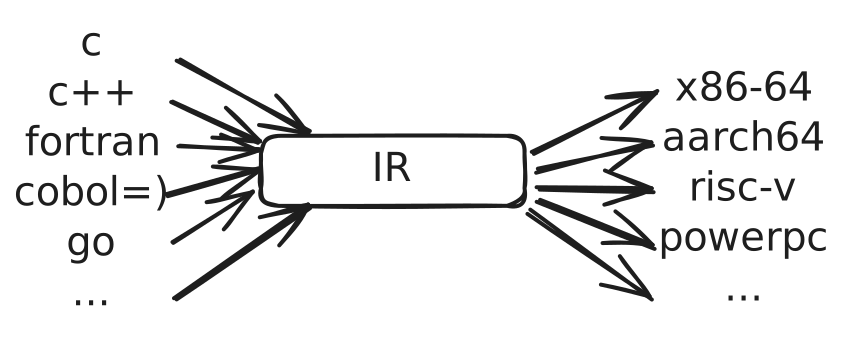
Did you know that GCC is not just for C and C++? Over the years, the GNU Compiler Collection has supported a wide range of languages. For example, until GCC 7, it included a Java compiler
gcj. As of version 15.1, GCC features Go, Ada, COBOL (since GCC 15.1 0_0) and many other frontends.
In GCC, most frontends first convert their AST into GENERIC — a language-independent IR. This is followed by gimplification, where GENERIC is translated into GIMPLE, a simplified three-address code IR.
Why not convert AST directly to GIMPLE? The answer is modularity and code deduplication. The conversion from GENERIC to GIMPLE is handled by a separate module called
gimplifier. This allows any changes to GIMPLE processing to be made in one place, without touching the frontends. Without GENERIC, each frontend would have to implement its own logic for lowering complex constructs and converting them to three-address code, which would lead to redundant work.
However, for C and C++, as of now, this mechanism isn’t used: GIMPLE is generated directly from the AST, since these languages are easier to translate straight into three-address code.
To view the GIMPLE representation of a program, use the -fdump-tree-gimple
flag. The general syntax for GCC IR dumps is -fdump-tree-<type>.
Middle-end
The middle-end or optimizer performs machine-independent optimizations on the IR. Its work can be divided into two parts:
- Analysis — the compiler gathers information about a program, such as building a Control Flow Graph, determining variables lifetimes and more.
- Optimization — a sequence of optimization passes is performed, each solving a specific problem. The order of these optimizations is defined in the compiler’s source code. Examples of such passes include: dead code elimination, constant folding, copy propagation and many more.
To inspect optimized IR at specific stages, use GCC’s -fdump-tree-<pass>
flags. For example, -fdump-tree-stdarg shows GIMPLE after optimizing variadic
functions.
After middle-end optimizations, GCC transitions from GIMPLE to RTL (Register Transfer Language) — low-level, Lisp-like IR that incorporates platform-specific details.
Although GCC’s middle-end primarily works with the GIMPLE IR, some of its optimization passes leverage target hooks to access backend-specific information, enabling architecture-aware optimizations while preserving a separation between generic and platform-dependent code.
Backend
Just as there are machine-independent optimizations, there are also machine-dependent ones. The backend handles these: it allocates registers (initially using pseudo-registers, which are later mapped to the CPU’s physical registers), chooses and reorders instructions, and performs various other architecture-specific optimizations.
The compiler’s last step is code generation, where the IR is translated
into assembly code. In cc1plus, this involves matching RTL patterns
defined in .md (Machine Description) files to generate architecture-specific
instructions. These files ensure deterministic code generation for a given
target platform. During code generation, pattern matching is performed,
registers are allocated (RTL pseudo-registers are replaced with CPU registers),
and, finally, assembly code is generated.
In the case of C++, code generation also includes name mangling — identifiers are transformed into unique strings encoding parameter types, namespaces, and other details. This enables features like function overloading and templates. C, however, doesn’t mangle names, which is why C++ code using C functions must declare them with
extern "C"to avoid linkage errors.
While the compiler’s job ends with the .s file, the process isn’t over yet!
Assembler
The next tool in the toolchain is the assembler. In the GCC ecosystem, this
is the GNU Assembler or gas.
During the assembly stage, assembly mnemonics are translated into machine code — each instruction is replaced by the corresponding binary code for the CPU command. An object file is created, which contains sections such as:
.text— machine instructions,.data,.rodata,.bss— global variables, read-only data, and uninitialized data, respectively,.symtaband.strtab— the symbol table and string table for symbol names,.rel.text,.rel.data— relocation information for code and data.
If the program is built with debugging information (the -g flag in GCC), the
object file will also include .debug_* sections. The object file may also
contain architecture- and language-specific sections, but that is beyond the
scope of this discussion. The assembler also processes assembler directives,
such as those that define the program’s entry point, code sections, external
function declarations, and similar instructions.
Linker
The last tool in the toolchain, but by no means the least important, is the
linker (ld in GCC, lld in LLVM). While the compiler processes
individual translation units, the linker combines object files into a single
executable or library.
In GCC, the linker stage involves an utility called collect2, which is a ld
wrapper. Its primary role is to handle global constructors (e.g., C++ static
initializers) and generate initialization code — a temporary .c file with
a table of constructors, which is added as an extra object module. These
constructors are then called before main() is executed.
In addition to compiler optimizations, there are Link Time Optimizations
(LTO). These optimizations involve cross-module analysis, which does things
like removing dead code, inlining functions or constants from other modules,
and similar optimization passes. When LTO is enabled, then object files
generated during assembly contain IR instead of machine code. A linker plugin
(e.g., GCC’s liblto_plugin.so) is then used, which optimizes these files and
convert them into final machine code.
After LTO (if enabled), the linker collects and merges the object files, and then symbol resolution takes place: the linker creates a global symbol table from the object files and libraries, searches for matches for each undefined symbol in other modules, and, if a symbol cannot be found, or if it is found twice, reports an error.
After all symbols have been resolved, the linker performs address relocation to ensure that all parts of program are correctly connected.
Why is relocation necessary? When the compiler and assembler generate object files, final memory locations of functions or variables are unknown. Instead of real addresses, they leave placeholders and create entries in a relocation table.
The linker assigns final addresses to each section, then goes through the relocation table and replaces all placeholders in the code and data with the actual addresses.
The linker also handles libraries:
- For static libraries, the linker extracts only the required symbols from the library and merges them with the other object files.
- For dynamic libraries, a reference to the library is added to a special
section (for example,
.dynamicin ELF files), and the library is loaded at runtime using this reference.
The next stage of linking is generating the executable format — the linker creates the structure of the executable file according to the target format. For example, when producing an ELF file, the linker generates the ELF header, as well as the section and segment tables.
🥳 And finally, we’ve reached this point — the executable file is created! 🥳 The linker writes the machine code, symbol table, relocation information, and dynamic library references into the executable. The result is a ready-to-use program that can be run on the target system.